Ep 23. Diem Fuggersberger on building a successful business.
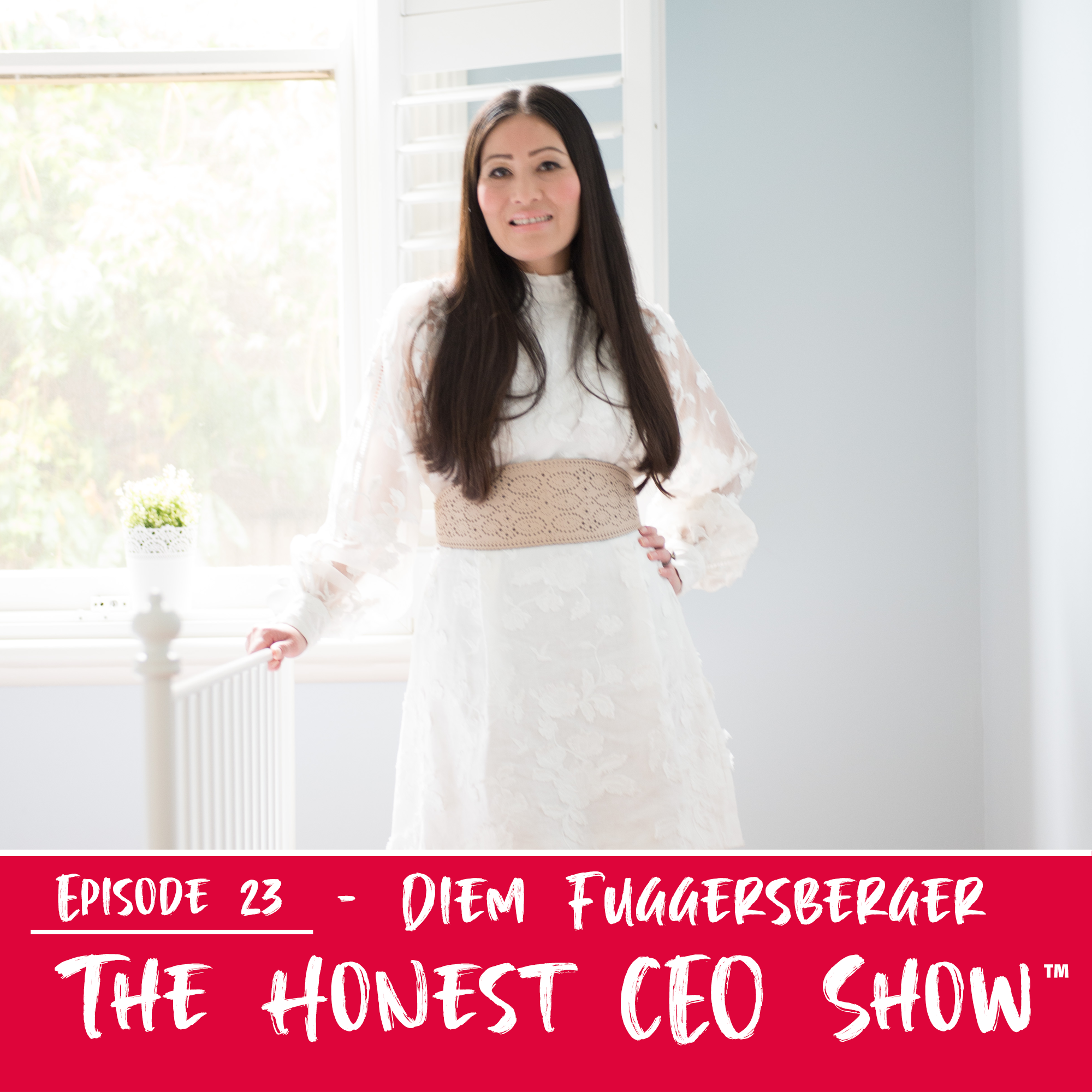
Diem Fuggersberger Successful Businesswomen
Arriving in Australia as a child refugee from Vietnam, with no belongings, no home, and no English, Diem Fuggersberger has risen from challenging beginnings to be a proud, passionate and values driven businesswoman. As co-founding CEO of Berger Ingredients, Diem and her husband Werner have built a multi-million dollar food manufacturing business. Berger Ingredients is now the supplier of many high profile food brands including Primo Smallgoods, as well as the home brands of major supermarkets including Coles, Woolworths and Aldi.
Diem is passionate about supplying Australian sourced, nutritiously balanced, sustainably packaged food into Australian households. She has recently realised her dream launching her food range Coco and Lucas’ Kitchen which is Australia’s first junior foodie range of deliciously healthy pre-made meals for 3 to 12-year-olds. The range is soon to launch through About Life and Drakes stores, with her vision to see the brand distributed through over 2000 supermarkets nationally.
In the episode, we cover:
- Diem arrived in Australia as a child refugee from Vietnam, with no belongings, no home, and no English. She shares her story with us.
- Diem talks about the multimillion dollar food-manufacturing business she built, and how it all began.
- Diem shares how she developed the skills necessary to run this type of business.
- Diem recently took out the Small Business Category at the Ethnic Business Awards? She shares how much this meant to her.
- Diem lost just about everything in 2009 due to the Global Financial crisis – she shares her story with us about losing it all again and rebuilding her life and business.
- We talk about Coco & Lucas’ Kitchen which is Australia’s first junior foodie range of deliciously healthy pre-made meals for 3 to 12-year-olds. I must say my son loves them.
- We delve into Diem's management style and the importance of leading as opposed to managing.
- Diem's business journey has been a bumpy one, as it has for most entrepreneurs - she shares the biggest lesson she has learnt in business.
- Caroline talks to Diem about the importance of succession planning, as a business owner you never know what is around the corner. It's critical that your business is sustainable without you.
- Diem shares her advice do you have for anyone struggling in business.
- Trying to build a business while bringing up children can be very challenging, Diem shares her secrets with us.
- Caroline is intrigued about what keeps Diem up at night.
- To finish up, Caroline & Diem talk about what the future looks like for Diem and her family.
If you are ready to Kick-Start 2017 & Make It Your Best Year Yet! The team at Virtual Executive are excited to help you achieve greatness. As an accomplished CEO and leader, our founder Caroline is thrilled to be able to share her advice with you, so you too can get remarkable results and success like she has.
Are you Ready to CHOOSE to Design Your Life? Build a Thriving Business and live your REMARKABLE DREAM life, a Life that YOU LOVE!
Episode Transcript
The Honest CEO Show, Episode 23: Diem Fuggersberger, CEO of Berger Ingredients
Caroline Kennedy (00:02)
Welcome and thanks for joining me today. My guest is Diame Fuggersberger, CEO and co-founder of Berger Ingredients.
Arriving in Australia as a child refugee from Vietnam with no belongings, no home and no English, Diem has risen from challenging beginnings to be a proud, passionate and values driven businesswoman. As co-founder and CEO of Berger Ingredients, Diem and her husband have built a multi-million dollar food manufacturing business.
Berger Ingredients is now the supplier behind many high profile food brands including Primo Small Goods as well as the home brands of major supermarkets including Coles, Woolworths and Aldi. Diem is passionate about supplying Australian sourced, nutritiously balanced, sustainable packaged foods into Australian household and has recently realised her dream, launching her own food range Coco and Lucas Kitchen, which is Australia's first junior foods range of delicious healthy pre-packed meals for 3 to 12 year olds, with her vision to see the brand distributing through over 2000 supermarkets nationally.
Welcome to the show, DM. Thank you so much for being here and congratulations for everything that you've achieved to date.
Diem Fuggersberger (01:58)
Caroline, thank you so much for having me part of the podcast. This is very exciting and it will be my first time so I'm very grateful for this opportunity. Thank you.
Caroline Kennedy (02:09)
You're welcome. Now you arrived in Australia as a child refugee from Vietnam with no belongings, no home and no English. It must have been a journey for you. Tell us about your childhood.
Diem Fuggersberger (02:24)
Childhood always has been colorful. As long as could remember, we left in Vietnam in 1979 and we came by a little boat to the big boat. So the big boat is the boat that takes us to the refugee island. It's called 001, the boat's name, and it was about 25 meters long with 501 people on the boat.
So we didn't have such a thing as having our own room on the boat. We'll get a little tiny space. And the boat captain has forecast for us to just have enough snack and water to get us to one of the Indonesian islands within three days. So we were basically, and this is my exaggeration, squash-like tuna. there's only, like there's no proper rooms to sleep or anything.
We were on the boat with all my relatives and my family and our nannies. So we were on the boat for about two days. After two days, we were intercepted by pirates, which took all our belongings. And after that, there was really, really bad storms and turbulence on the sea and they nearly capsized our boat. And then about six hours later, we were saved by another boat called Bologna.
And it's an experience where I remember, the majority of the people that were on the boat out of 501 people, probably only one fifth of the people could swim. So if one of us fell into the water, that's it. We could just all drown and die. So after the turbulence of getting robbed and the storm, there was another thing where they nearly took my two cousins and we thought that they were going to rape them.
But luckily something happened and they gave our cousins back to us. So when the boat that saved us, I remember climbing up the ladder to the big boat. I never forget that experience because I felt like if I actually fall down that ladder, I would just die. So from that big boat, it took us another day to get to an island called Galang, which is a refugee island in Indonesia.
Caroline Kennedy (04:49)
Yeah, and how old were you at that time?
Diem Fuggersberger (04:53)
I was seven years old. I remember that my mom had to cut my hair back short like a boy to look like a tomboy so I won't get attacked on the boat if there were pirates. We were aware of the pirates along the way. And being on the refugee island, we live in a long house and we share with five other families.
So the only way to separate the rooms, was just simply a piece of material like a curtain that we put up and we stayed there for 15 months. One of my uncles who arrived in Australia in 1978, he had seven sons and my uncle did the executive decision to have all his sons sponsor the five families that were on the refugee islands.
So we waited for anywhere between 12 months to 24 months for all the care family to arrive in Australia. So we have to wait and make sure that our health and everything has ticked all the boxes for our visa to get approved. And when I was on the island, there was two things that I never forget is one of the families that stayed on the same long house with us.
He committed suicide and that was my first experience because he didn't want because to get a visa the whole family had to be held 100 % for Australia or America or Germany to take us and he felt like he was holding his family back so he had epilepsy so he committed suicide and the other thing was there was malaria so you know there was kids dying every single day but at the same time my childhood where we had so little to play with, know, just pick a stone or just going to the beach and having a shower in the forest. It's just, you know, I was young, like I didn't, all these things sort of shaped who I am today. Yeah. Yeah. So there was the experience that there was the beautiful Navy experience as well.
Caroline Kennedy (07:15)
Yeah. And I'm sure that it's that experience and a lot of people who go through a challenging childhood, they're resilient and their resilience allow them to, to just push through anything and push through really challenging times. And I mean, you've built a multimillion dollar food manufacturing business, you know, and to do that, you would have needed a lot of resilience, but tell us where did it all begin?
Diem Fuggersberger (07:47)
This journey started as I believe I want to credit all the little jobs that make me who I am today. So my really first job was selling clothes at a flemish market. And I think that taught me survival because I was very young. I was like 14. So I had to pretend to act colder so no one could who in a way to protect myself and to look after myself. think that's where my resilience started and also when I arrived in Australia, back in the 80s, Asians or refugees were not so easily accepted. So there was a lot of bullying. So that also made me resilient.
Then my first real-world job was working in a duty-free for about six months. And then I've moved into working as a cosmetic consultant. That also is something that I love to do. And then I work and then my next job was working at Optus as an international operator and that gave me insights to talking to a lot of international operators around the world. That's why I know all the country code. Then I used to not just do a full-time job at a corporate firm but I come home and help my mother with her restaurant and that I think that actually was the first real business that taught me business skills.
And my mom, when as young as when I was around 15, mom started making me roll 1800 spring roll perfectly in three days and one time. And that's where I start waitressing and handling money. It's the start of what business is without unconsciously I didn't know that was the start of the business for me but now I look back at it. need to not, I don't know why I thought, my mom, she's following me, she's making it work so much but she really shaped the beginning of my business. But how I found it, those ingredients in 2009 was out of necessity.
Caroline Kennedy (10:02)
What kind of necessity?
Diem Fuggersberger (10:04)
Because in 2009, through the financial crisis, through my husband's business, the fail of my husband's business called Quality Ingredients, he built it up in 15 years to 120 employees with a $30 million turnover. So the business collapsed due to three things at the financial crisis that in 2008.
And then we went through bad management and then through also, you know, two huge clients didn't pay us a lot of money in the millions. And fourthly, we moved from a small factory to a 20,000 square meter factory and, you know, to buy the land and the factory and the renovation of the new factory has also crippled our cash flow. So in 2009, we lost everything. Caroline, for me, that's probably the worst thing that ever happened to me because I wasn't at all, could understand to lose everything and it was worse than just arriving in Australia because that, and I said to my husband, I came to Australia hoping for a better life, but in 2009, we were in debt to my family $900,000 and we were homeless. We didn't have a car and then I still had two children to raise, you know. So I have a choice to either, you know, I say forget about everything and move to another state and not take responsibility. Or I have a choice to have a good cry and mobilise my whole family and work with my family and just, you know, really negotiate my way through everything.
If you ask me what I do today, I couldn't believe I did it in 2009. I tried to, I think it's all about good negotiation and asking people to work with you. So in 2009, 28th of July 2009, that's when my husband lost everything. I don't know what happened, Caroline, but on the 20th of August, I started to apply an ABN online to start Berger Ingredients. And Berger stands for, in German means mountain. So when I, and it's half of my surname, and I wanted to have a company that represents half German. Yeah, so that's when I started Berger Ingredients.
Caroline Kennedy (12:36)
Congratulations because, you know, the story you've just told us, what I take out of that firstly is that adversity really does make you stronger. You don't realise until you go through a really challenging time and you hit rock bottom just how strong you are and clearly you're a very strong woman.
And I think for our listeners, the lesson there is, and I love that you can articulate the key reasons why the business failed and first bad management. And that is so true. If you're a business owner, even if you have management within your organisation, you need to be across all of it. You need to be across the numbers. You need to be across what's going on in the business. That doesn't mean that you need to do it.
But you certainly need to have visibility on everything because at the end of the day, the buck stops with you and it's your business, you know? And then another key point I took out of that for the listeners is from a business perspective, you know, the risk factors associated with being reliant on big clients. So for instance, you said two of your clients didn't pay the bills and they millions of dollars, which says to me that that they were from a market share perspective, were a couple of your biggest clients. And as soon as you start to rely on one source or two sources of massive income and something affects them, then that has a flow on effect to your business. So I recommend for all businesses to really be conscious of their business source and the percentage of business that comes from each of those client basis as well to minimise that risk to a business.
Well done for overcoming it to be the success that you are. I mean, there's so many people that wouldn't have been able to do that and it's such an achievement for you. Now I love your brand, Coco and Lucas Kitchen and personally my son.
As I've said to you, he loves eating them and they're so nutritious as well, especially for busy moms. And there's many of us out there that care, you know, really want our kids to have nutritious food and I love the product. So I'll tell the listeners a little bit about it. So Cocoa and Lucas Kitchen is Australia's first junior foodie range of delicious, healthy, pre-made meals for 3 to 12 year olds. And you can find it many stockists throughout Australia, but you can also obviously go on the website and in Victoria. That's where I get it from. So tell us a little bit about starting that business and the journey there.
Diem Fuggersberger (15:28)
This is, even today I can't actually believe that I launched Coco & Lucas and how well not just Australia has taken the brand but internationally. Like I'm actually in the talks with people like Middle East and Asia and China and even Europe. you know, when I started those ingredients, I said to my husband, you know, I didn't know anything about ingredients but I just know that I love the food space. So for five or six years, the first five years Caroline, Berger Greetings helped me pay off all my debts and it's a business that's very close to my heart. And you know, as I told you before earlier, my background is, you know, I just love beautiful things and I love art and I love fashion. And I said to my husband, you know, for five years I really love, you know, making food for those ingredients like in the small good industry but can I just do something that I really love and I have two kids and I've never feed my kids food on the market because I'm just I'm a person that looks at everything like I looked at I put myself as a customer like why I'm not buying this product and I thought there is a get in the market.
There is a get for there's food kids between 0 to 4 and there's food for adults. But there isn't food for the space of what I call junior foodies between 3 to 12. And I did my research and the portion is around 220 gram and some kids might eat more than that and some kids might eat less. So and when I launched Coco & Lucas, I'm inspired by the two, three people in my life.
It's firstly my daughter, who is a picky eater and she always wanted me to cook her meals and it has to look perfect and it has to be beautiful. And there's Lucas who is my great nephew. When he was born, he had all these food intolerance and being Vietnamese, we didn't know what food intolerance means. So he was always sick and crying and had itchy skin and was just losing weight really rapidly because everything he eats, can't maintain it.
So we went to see obstetrician, a pediatrician to understand why he's not holding his food in and he had intolerance of gluten, lactose, seed, peanuts, fish and seed. It took me really, by the time Coco & Lucas is launched, really took me two years Caroline because I didn't want it just Coco & Lucas to be a marketing brand. I wanted to be Australian brand that and a national brand that Australian love and it took me one year to build my kitchen to you know food safety has a certified with WQA, SQA, Australian certified organic has it to make sure that we are actually compliant with WQA and quality assurance and quality control and I invested over two million dollars in my kitchen to build that commercial kitchen which can generate over three million meals a year. So that was my number one thing to do and then I did, I didn't actually pull any extract or data research from any food company.
I actually went out and did my own research and went with my gut feeling and at first my family were a bit skeptical because they said to me, you you're Asian, you're a refugee, you're not one of the big boys. Who's gonna buy your food? And I think for them to say that to me, it actually trickled me to work 10 times more to prove to them, if it doesn't mean, if it means if it hasn't been done before, it doesn't mean it's not gonna work. So I asked myself one question, you know, why would anyone dig so deep in their pocket to pay $5 for my meal sets in Woolworth and for the gluten free and lactose free range $5.99?
So I looked at nine things: I looked at nutrition. So my meals is a balanced diet of protein, vegetables, and carbohydrates. And number two, I look at convenience. Parents can just buy my food and put it in the microwave and within three minutes, it's ready to eat. And number three, I looked at age appropriate. And my meals are actually low sodium and it's the perfect size for the junior foodies.
And then I look at being environmentally responsible. So most of my packaging, 90 % is biodegradable. And then I look at child obesity because more than 25 % of Australian kids are overweight. And I look at the junior foodies movement. So kids these days, if they're nine, I think they want to act like 12. And for them, it's just not eating out. They want to take Instagram. They want to be on Facebook. They're very trendy so I looked at that as well and I look at increasingly time poor for parents. So most parents work these days and they don't want to feel guilty and they want to feed kids food that is nutritionally balanced and I look at that demographic growth. So between the 3 to 12 years old demographics, 12 % of Australian in that age group is growing more and then I looked at children's food intolerance like the gluten and lactose. And then I want to make sure that it's at the magic number five because mom wants, as soon as you say to someone the product is handmade or it's source 90 % Australian produce, it shouldn't be $9 because parents can't pay that much.
And if you've noticed all the photos artwork on my branding is photos of my real piece and I turned that into, I was inspired by Banksy Art and it's a brand with a lot of substance, with integrity, authenticity and it's a brand where for me it's not about making money, but it's about giving back to the Australian, to our community and that mom feels very safe to buy my product.
So that's how Coco and Lucas was born.
Caroline Kennedy (22:19)
I love that story and particularly a couple of points is the fact that you did your research. You identified a gap in the market. You understood the challenges that parents go through with trying to balance everything that they've got going on and convenience is key. But so is also taking care of their kids and feeding them nutritious food, which is vital. And I know as a mum, that's it's really challenging to balance everything and you do get that guilt. So you've ticked a lot of boxes there, but most importantly, I think is I love your passion for a food, but also wanting to make a difference and wanting to give back to the community because that's so important.
I've always said in business and my values are very much around in business, putting your team and your customers first and everything else will follow and, and doing the right thing by, you know, the people within your business. Cause it's the people that make your business. And when I say people, I mean customers and team and, and it's, it, this is exactly what you're doing and you're, you know, you're achieving a lot as a result. And I think once you, you know, we talk about integrity and once any business starts to look at the market and see how am I solving a problem, how can I contribute and give back, it changes everything, you know.
Diem Fuggersberger (23:52)
It does because you know, didn't for me, I didn't for me it was for my passion. The dollar sign was never first on my list. It was my passion. And I really think when you're so passionate and I want to use the word compassion as well because I do everything with compassion and I'm not scared to say this. Like I could actually have the two and a half million dollars and buy a home and be happy but I was not satisfied.
And if I was lucky, I would just break even the first year and I'm not embarrassed to say that because for me, satisfying the consumer was number one priority for me and I wanted a brand with authenticity. And if people, you know, hear and can feel what I stand for, I will know in the end, you know, they will always support me. And it's my legacy to have that good name, like it's important to me, know, reputation is everything.
I just really do believe and I have faith that the brand will go far because I think it's a very genuine brand.
Caroline Kennedy (25:01)
Yeah, very much so. And I think that that comes through even in your brand packaging and everything that you've done for the business and for the consumer. You recently took out the small business category at the Ethic Business Awards. Congratulations.
Diem Fuggersberger (25:19)
That was very special.
Caroline Kennedy (25:22)
What did that mean to you?
Diem Fuggersberger (25:25)
It means so much to me, for me it was, you know, it's also for me the most because you Caroline, when I came to Australia, I actually lived in the worst suburb, you know, a suburb where there's a lot of criminal rate and you know, I went to the worst public school and the worst high school. So I just want to, you know, it was an application that was you know, was 500 applications, over 47 nationalities. And I just want to inspire other people. And I think since I wonder what so many people who were having the same background to me, like I've inspired someone to say, you know, you can do it, like through, against all odds, or regardless of what happened to you, or what background you come from.
You can do it if you put your heart and mind to it. And I just want to show people that based on how I got here, I've actually had so many knockbacks and failures and losing everything. Like if I looked at all my losses, I've actually lost three times in my life. The first time was losing our house and our dog to come to Australia. And then we lost again through you know, that the pirate, Robin on the boat. Then, you know, in 2009, I lost everything again. So I've lost a lot of big, tremendous things in my life three times. And I just think just because I lose everything, I can actually, you can make it. So for me to apply that award, it's also representing my heritage. I'm half Chinese, half Chinese. So it's, I want to inspire people to be able to, to, do what I can do. If you put all your heart and your passion and absorb all your possibilities, anything can happen.
Caroline Kennedy (27:24)
That's very true. And as you've just described, your business journey has been a bumpy one and that, know, it is as an entrepreneur, the journey is has its ups and downs and we go through that on a daily basis. And a lot of entrepreneurs feel that. So what, what would be the three biggest lessons you've learned in business, Diem?
Diem Fuggersberger (27:48)
The three business lessons is to have any successful business, I think number one: you need to treat your staff really, really well and you need to really understand your business inside out and I think what works for me might not work for anyone else but I like to really engage very deeply with whether it's my staff, my client, my supplier, my bankers. I need to know every single of my business and even if it means like I'm not doing those jobs, I need to be entrenched and engaged in all those important roles that make the business successful. And I think for me that having a brilliant idea or having a brilliant product is not enough.
You need to be, you know, like a business and I'm lucky that I work in a corporate because corporate has, I used to work for Optics. It taught me to understand about a lot of things like cost centers, discipline. It taught me about team playing. It taught me about HR. It taught me about administration. It taught me about cash flow. So I combine all the things in my life and journey to make my business work today. And firstly, I think you have to be very unique in business.
Like you need to offer a product that is very unique and authentic and original. Like you need to make a difference in your business to stand out. That's my top three thing. And I think, you know, in business, you know Caroline, I have stuff up and I have made decisions that are wrong, but I think you shouldn't take it as a negative thing. You need to learn from it. You look at it as an experience and learn from it and do things differently the next time. So I think learning from your mistakes and being resilient is very important as well.
Caroline Kennedy (30:01)
Yeah, I agree with you completely. And I think there is so much to be gained from the learnings from our mistakes. And at the time, it doesn't necessarily feel that way. But that's where you really learn a successful business person never makes those mistakes again. Yeah. If something happened to you, what would happen to your business?
Diem Fuggersberger (30:23)
It will still operate because I have invested in the last seven years, you know, like everything on my staff. Because when you have such a strong team and because in my business, there's different areas, you know, there's the warehousing, the research and development, there's the school science part, there's the manufacturing, there's finance, there's quality assurance.
And I think in the last seven years I have invested and I didn't get paid very well. I'm talking about under 30,000 a year for the first five years because I invested a lot of my genuine time, lot of caring and love. And I invested a lot of money in my staff to make sure I think they're very loyal, they're very sincere and they work with me in harmony and they treat my business like they fix their own.
So I think nothing will change, Matt, except R &D will probably slow down a little bit because I'm the visionary person in business. So I'm the person that's always coming up with the new product, the new visionary. So that will probably slow down a little bit. But other than that, all the other areas are very well covered. So it will still run smoothly.
Caroline Kennedy (31:43)
You know how pleased I am to hear that that is exceptional because as a business owner and I've always said in even when I've run private businesses and corporate that if I got my role is if I get hit by a bus, this business still goes on and that should be a primary focus for any executive leader or entrepreneur business owner because it's so important that you know, you're looking at what a succession plan look like, how your team are functioning. And as you said, the culture within the business is such a positive culture that they want to do right by the business. They feel like it's their own business by the sounds of it.
Diem Fuggersberger (32:31)
Because you need to give the people, like in our, I've learned from my grandfather that, I asked myself a question Caroline, do I want a business that lasts five years or do I want a business that is 50 years or 100 years? So I need to, if you want a long lasting business, then there's a saying, you have to eat last, which means in our culture that you need to invest all in your people to make sure that they feel they are the most important, that they feel like they have the empowerment to make the changes. when people have that empowerment and the trust and the loyalty and they think it's their business, they're more likely to their heart and they stay loyal. You bring the best out of people and people are more visionary. And I don't mind that my staff are smarter than me and i am one of those leaders that like to hear what contribution they can give me because they don't want to do the work every day what i have uh... you know because I've created all the ball it doesn't mean that under this person creating that role because if they account that they might find my people and they do it every day they they probably have a better way of saying to me you need to we do this way because it's more is more economical, if you get a KPI at the end, and I need to listen to my people. But at the same time, like I said, Caroline, I'm not a marketing company. I own my manufacturing. I'm in trench, I'm engaged. I'm there every day because I looked in my last 45 years, all the businesses I see in front of my eyes.
The owners are there working with the staff and there's nothing that I wouldn't do. You know, I do everything for my staff and I work with my staff. The only thing I can't do, I can't drive a forklift and I'm not very good with IT. I can't do those two things. But you know, I know all the roles very well.
Caroline Kennedy (35:07)
Yeah. And it's so important as well to, as a leader, to be able to get to know the roles within your business and then step away, as you said, and empower people to, to improve and to make recommendations and suggestions. And, and when they feel empowered, they do so much better and they, their performance increases and, also to get your hands dirty, you know, the, the, the old management style of sitting in your ivory tower and giving directives is just, it's old school and it doesn't have a place in today's management style. It is very collaborative and about leading your team to success and being that true leader. it's so important. So well done on doing that and having that philosophy. It's great. Now, Diem, what keeps you up at night?
Diem Fuggersberger (35:29)
What keeps me up at night is I think my children, by saying that for me business is very important to me but I've always said that my family and I work with an extended family so there's 30 family members, nearly half of them work with me and what keeps me at night is I think I believe in tranquility, peace and harmony and balance. So I personally think for me is I need to have my family intact, happy and I know my kids are in the safe place and I take them to school every day and when I know that they're they're the people that inspire and keep me going because I do want to be a good business so I can share with my family and naturally it will keep my children a better living of standards. I'm not talking about spoiling them with material things but I'm able to have a bit of money left over to extend the curriculum and for them to experience the world. And for me, I believe in collaboration and I'm a big collaborator. I love innovation. So sometimes I just wish my mind would stop working, but it just never stops. So maybe I'm just too passionate and I know that, I'm just passionate. just, for me, it's not work. It's something I love doing.
Caroline Kennedy (37:10)
And I completely agree with you. I love that you say, you know, I wish that my mind would stop working, I had that trouble as well. Even when I'm sleeping-- it's going going going. It'd be nice if it's quiet for a while. But that's what we love doing, right? I mean I know for myself, what you just described. I love what I do, it's not a job. I'm motivated by it. It's not a chore, that's why I dedicate probably too much time to doing what I love. But that's okay. Now, as we wrap up, what advice would you give for someone struggling in business?
Diem Fuggersberger (37:52)
I think for me, I'm here today because and this is one of my favorite line is failing is not an option. I think you need to give any business time and you need to truly believe in it. And if you think you work hard, you need to work harder because when the success kicks in, then it's very satisfying. And I think when you're working on a project, once you make up on your mind, you need to be very determined and focused and work at it and work at it work at it because I sometimes want I make my decision then I just talk about that decision or what my project. only work, I only talk to the key people that I trust in my life and I work together with my team and make it a success, a success to make it very focused. So, yes, so I just think, just truly believe what I've always went with my heart and my intuition Caroline because I think it gives me 99 % of the time the right answer.
Just believe, have a vision and believe in your heart, your intuition, what you want to do but always do things. You know, whatever you do, has to be, like I said, I'll repeat again, it has to be about making a difference. It's about contributing back to the community. It's not just about oneself. It's about collaboration. It's being unique and make sure all the important roles in the business or the key roles or understand your business very, well. Because you just can't focus on one thing and let the other things go astray. You have to, I think, be passionate about it. Yeah.
Caroline Kennedy (40:00)
And finally Diem, what does the future look like for you?
Diem Fuggersberger (40:04)
The future is extremely exciting because burger ingredients is growing steadily and it's going at like just this is the end of the year. So we always work nine months in advance for burger ingredients. So in the last few days, I've actually been given six new projects and I normally don't announce it until the product launch, celebrity chef. I'm working with, what I love about those ingredients is it's got a list of who of the who in Australia and they are all blue chip clients. But I think Coco and Lucas is gonna be the big big baby for me because I am just so overwhelmed that it's not just been recognized within Australia but I'm getting a lot of international recognition.
Australia is one country but export is the world and for me it's very overwhelmingly exciting because for me it's about seeing my product on the shelf not just in Australia but around the world and I think that my passion from making a change has really paid off in after two years. I'm just really happy about it. I'm just generally very happy that I've actually launched a product under my own name that's going to be potentially an international product. By saying that, when I launched Coco & Lucas, it's also a learning curve for me. I didn't know that you're going to launch a national boot launch you need to have a strong media PR team to go with it.
So when I launched Coco & Lucas, I only had Instagram, I only had Facebook, I only had LinkedIn. But to bring a product to a national, international level, you really need to work with a very strong marketing, PR, and media team. And I'm looking at at least spending in the new year, another 200,000 to 300,000 to inject in that area to grow to the business that everyone knows about. you know, this is all, it's an exciting time, but it's also a learning curve time for me.
Caroline Kennedy (42:39)
It sounds like it's very exciting. And very well deserved. And I think that fact that you're able to recognise that you need to continue to learn, which is so important. As soon as we think we know everything, we limit ourselves, because nobody does. No matter how old I live to, I'm going to continue to learn and be a sponge and soak everything up. That's what I love doing. You keep developing and growing and that's exciting. But taking your business globally is very exciting and the other projects that you've got as well sound like you've got so much going on, you know, but it's well deserved and, and you should be very proud of what you've achieved.
Diem Fuggersberger (43:24)
Thank you, Caroline. I mean this means a lot to me that firstly, you're not a woman that supports another woman. I'm actually really overwhelmed that just to even get an interview on your podcast today is overwhelming. I know the entrepreneurial ladies that you have interview and they're all women that is part of my network and they're all ladies that inspire me and you know like they are amazing ladies so I feel very honored and privileged to get the opportunity today.
Caroline Kennedy (43:59)
And I love sharing amazing women's stories. I think it's so important to support each other and, and support where we can and help where we can, as opposed to there's too much, know, where people put each other down or there's competitiveness. I just don't buy into that. And I think that there's enough space for everyone and you know, supporting each other and helping each other is so important because life's too short and give why you can.
Diem Fuggersberger (44:28)
Definitely. I really want to also add that, you know, like today, for example, it gives me a boost too as well because, I work with a family where I'm the only girl in the family and I'm actually the second youngest. And sometimes I feel alone. just having, knowing that I have women around you, I'm not alone. So it gives me that sense of community and, you know, I know at least I have someone to go to and talk. It's beautiful. Thank you.
Caroline Kennedy (44:59)
Welcome. Thank you so much for your time today I really appreciate it and good luck with everything.
Diem Fuggersberger (45:06)
Thank you, thank you so much.
Don't miss an episode of the The Honest CEO Show by subscribing on iTunes, Spotify and if you love our podcast leave a review.
Your host
Connect with us on twitter
Email us
OVER TO YOU…
What was your biggest take away or ah-ha moment from this episode?
Leave your comment below.
We'll respond to each and every comment.
Share the love!