Why Some Leaders Experience Leadership Breakthroughs While Others Don’t
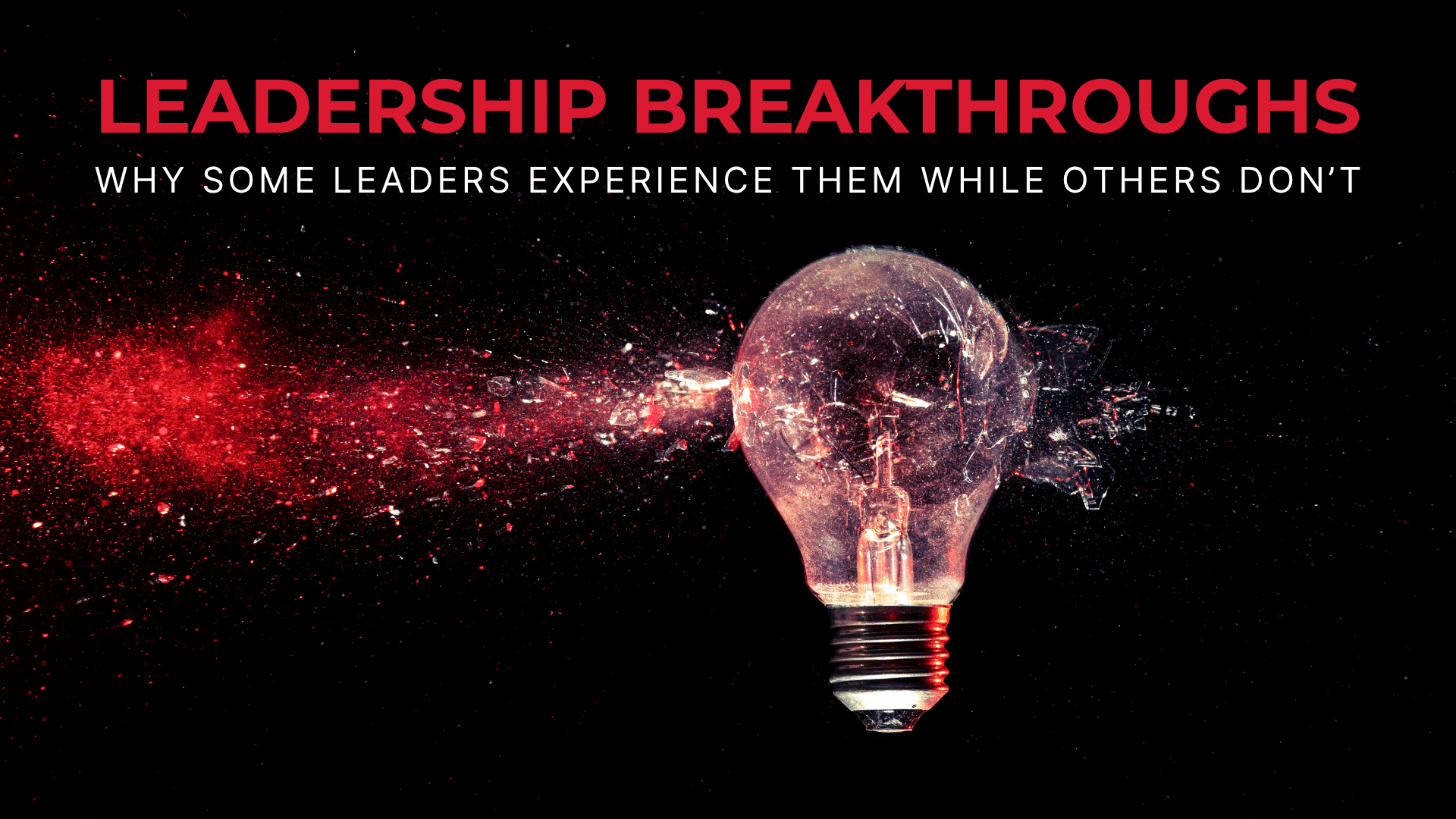
Why Some Leaders Experience Leadership Breakthroughs While Others Don't?
By Caroline Kennedy | Published May 28, 2026
The most important leadership lesson you'll ever learn probably isn't one you've never heard before.
It's one you weren't ready to hear yet.
Two CEOs can sit in the same room. Listen to the same keynote. Read the same book. Work with the same coach.
One walks away with a breakthrough. The other wonders what all the fuss was about.
The difference isn't intelligence. It isn't experience. And it usually isn't the quality of the advice itself.
It's timing.
A challenge you've been quietly wrestling with for months suddenly becomes impossible to avoid. A decision you've been circling around finally becomes clear.
The advice wasn't new.
Your timing just finally was.
The gap between hearing executive advice and acting on it isn't a failure of content. It's a failure of growth-stage timing. A CEO experiences a genuine leadership breakthrough only when the insights they encounter map directly onto the specific friction points of their company's current scaling phase. Leadership development is not determined by the sophistication of information consumed. It is determined by the operational readiness of the leader receiving it.
What Is the Leadership Relevance Gap? (And Why Most Leadership Advice Feels Like a Cliché)
Many executives operate under a flawed assumption: that professional breakthroughs come from finding better, more novel ideas. In reality, scaling a business almost always requires encountering the right idea at the exact right moment.
Every leader in a position of authority has absorbed phrases like these:
- "You need to delegate more."
- "Empower your middle management team."
- "Work on the business, not in the business."
To a founder running a lean, fast-moving startup, these phrases can feel like polished clichés: well-meaning, but disconnected from the operational realities of Monday morning. But to a CEO whose organisation is actively bottlenecked by operational complexity, those exact same phrases can become a genuine turning point.
The advice itself never changes quality. What changes is whether the leader is experiencing the specific pain point that the advice was built to address. When an insight doesn't connect to a live, active business challenge, the brain files it under irrelevant background noise and moves on.
This is a phenomenon called Leadership Relevance Gap: the invisible friction point in executive development that explains why two founders can read the same business book and walk away with completely different outcomes. One unlocks a significant operational breakthrough. The other closes the cover wondering what all the fuss was about.
What Are the Scaling Milestones Where a CEO's Core Bottlenecks Shift?
The primary reason business advice lands so differently across leadership teams is that corporate challenges undergo fundamental mutations as a company grows. What serves as a foundational strength in one phase will, without adjustment, become a structural limitation in the next.
To optimise leadership development, insights must be mapped to specific revenue milestones and the shifting responsibilities that come with them:
| Growth Stage | Revenue & Context | Primary CEO Bottleneck | Required Leadership Shift |
|---|---|---|---|
| Stage 1: Execution | $1M to $5M (Lean Team) | Tactical Over-Involvement | From Doing to Delegating |
| Stage 2: Leverage | $5M to $20M (Expanding Org) | Operational Complexity & Bottlenecks | From Managing to Aligning |
| Stage 3: Scale | $20M+ (Enterprise Level) | Executive Misalignment & Silos | From Problem-Solving to Culture |
How to Shift from Execution to Leverage ($1M – $5M)
An executive leading a $1 million company is, by necessity, anchored to execution. At this stage, staying close to the product, managing daily operations, and personally driving revenue isn't micromanagement. Speed, agility, and deep involvement are competitive advantages.
But as headcount grows, those same traits begin to stall progress. The founder who built a company by having a hand in every department rapidly becomes the single biggest operational bottleneck. Decisions slow. Team autonomy erodes. The central challenge is no longer execution, it is structural leverage.
How to Shift from Leverage to Scale ($5M – $20M)
At this middle phase, the CEO's role shifts from doing to aligning. Operational complexity multiplies faster than the team can absorb. Systems, processes, and middle-management capability become the real competitive differentiators. Leaders who remain stuck in execution mode at this stage find themselves constantly putting out fires they inadvertently started.
Making this shift requires things that most CEOs are never formally trained to do:
Invest in your middle management layer before you think you need to. Leaders who wait until complexity is already overwhelming typically find themselves trying to build a bridge while drowning. The time to strengthen management infrastructure is during a period of controlled growth. Identify your highest-potential middle managers now and build their capability proactively.
Shift from solving problems to building systems that solve problems. Every time a challenge lands on your desk that your team should be able to handle, the right question isn't what is the answer? It's why does this keep coming to me? Build the process, train the person, or create the decision-making framework that removes you from the equation permanently. Your goal is to make your own involvement structurally unnecessary.
Create explicit alignment mechanisms. At this stage, misalignment is often silent. Teams believe they are working toward the same goals while quietly pulling in different directions. Regular strategic alignment sessions, and not status updates, become one of the CEO's most important recurring commitments.
Enterprise Culture and Executive Alignment ($20M+)
As an organisation moves past $20 million, another fundamental shift occurs. Abstract concepts such as corporate culture, communication architecture, executive clarity, are no longer soft peripherals. They become the primary mechanisms that determine whether the company can continue to scale at all.
The CEO is no longer responsible for executing work. They are responsible for architecting the cultural conditions that allow their entire executive team to perform without constant centralised input.
Why Executive Breakthroughs Always Feel So Obvious in Hindsight
When executives describe a genuine leadership breakthrough, they nearly always reach for the same phrase: "I’ve always known that, but I finally understand it."
What evolved wasn't the data density of the information. What evolved was their proximity to organisational pain. The advice that once felt basic or overly simplified transforms into an indispensable truth because the leader has finally paid the painful tax of ignoring it.
A founder can be told for years to stop serving as the central clearinghouse for every internal decision. They agree. They change nothing. Then growth flatlines because every major initiative is sitting in their inbox. Their leadership team is frozen, waiting for sign-offs. The business cannot scale a single step further without a structural shift.
Suddenly, that familiar, slightly tired piece of advice becomes transformational because it is no longer abstract. It is the direct answer to a high-consequence problem sitting on their desk right now.
Why Traditional Executive Development Programs Fail Growing Companies
When corporate boards and HR teams design leadership programs, they typically ask the wrong question: How do we get our executives to engage more deeply with this development content?
The better question (the one that actually drives behaviour change) is this: What specific, high-friction operational challenges are our leaders trying to solve right now?
When professional development is built around the live strategic realities an executive faces on Tuesday morning, engagement stops being a problem. Attention follows relevance. The most effective leadership experiences are never built around information depth. They are built around precision of fit.
Modern executives don't need access to higher volumes of content. They need sharper contextual filters ; mental models calibrated specifically to the friction points that come with rapid corporate scaling.
Here's the trap: Most executive development programs are designed around what is most convenient to deliver. A fixed curriculum, delivered on a fixed schedule, to a room of leaders at wildly different growth stages, will always produce wildly uneven results. The format isn't broken. The assumption is: that the same content, delivered at the same time, will be equally relevant to everyone in the room.
A CEO Diagnostic: Are You Ready for Your Next Breakthrough?
Use this diagnostic to audit your current growth readiness and identify which insights actually deserve your attention right now:
- Audit Your Calendar and Time Allocation
Review your last 30 days of meetings and tasks. Are you spending more than 50% of your energy solving immediate daily fires or are you architecting long-term alignment and strategy? Your calendar doesn't lie.
- Identify Your Active Operational Bottleneck
Pinpoint exactly where projects slow down inside your company. If initiatives stall because they are waiting for your direct review or approval, your primary challenge is a structural leverage issue, not a capability issue.
- Ruthlessly Filter Extraneous Information
If you are navigating a $3M execution phase, aggressively tune out enterprise-level advice on corporate governance and matrixed structures. It isn't irrelevant content , it's simply irrelevant right now. Focus on scaling your delegation capabilities first.
- Map Your Leadership Development to Active Initiatives
Stop consuming generic business content at random. Tie your executive coaching, reading, and workshops directly to the top two strategic priorities on your current quarterly goals. Everything else is interesting noise.
- Audit Your Team's Relevance Gap
Leadership breakthroughs shouldn't stop with the CEO.
Once you've identified your own active bottleneck, turn the same lens on your direct reports. Ask each of them directly: What is the single biggest friction point slowing you down right now? What development, guidance, or insight would actually be useful to you in the next 90 days; not in theory, but right now, given what's on your plate?
The answers will tell you more about your organisation's genuine development needs than any annual performance review or standardised training calendar. A high-performing leadership team isn't one where everyone has consumed the most content. It is one where every leader is receiving the right insight at the exact moment they need it.
The Relevance Gap doesn't just live at the top. It runs through every layer of your organisation.
Final Thoughts
The most powerful leadership lesson is rarely the most sophisticated, the newest, or the most intellectually complex. It is simply the one that arrives at the exact moment an executive is finally equipped to deploy it.
That is why two CEOs can sit in the same boardroom, listen to the same strategy, and walk away with entirely different outcomes. One hears another familiar platitude. The other discovers the precise key that unlocks their next phase of growth.
The advice was always there. They just finally needed it enough to hear it.