AI Fluency for Non-Technical Executives: A Leadership Roadmap
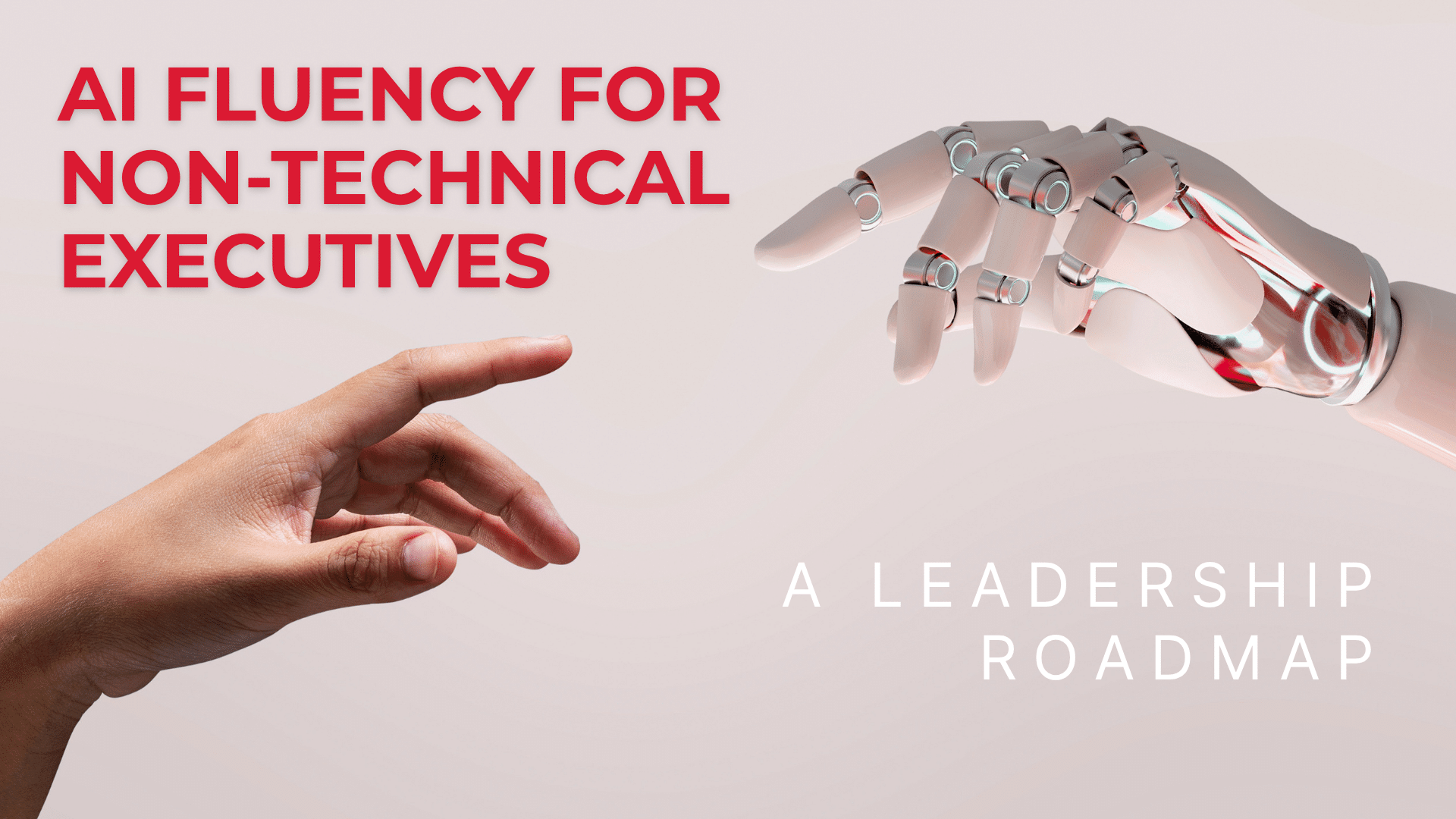
AI Fluency for Non-Technical Executives
By Caroline Kennedy | Published May 04, 2026
I still remember a moment I won’t forget. I was in a strategy session with a leadership team of smart, experienced people who had built genuinely impressive businesses. The conversation turned to AI, and within minutes, the room split in two. Half the table spoke in acronyms and model names; the other half nodded along with expressions I recognised immediately as polite concealment.
No one admitted they were lost. No one asked the question they were actually thinking. And when the meeting ended, the company’s AI roadmap was handed to the most technically vocal person in the room, not the most strategically capable one.
That’s the gap this article is about. Not the gap between humans and machines, but the gap between executives who understand enough to lead and those who have quietly decided that AI is someone else’s department.
It isn’t. And the cost of that assumption is becoming very clear.
What is AI Fluency?
AI fluency for executives is the ability to connect business problems to AI-enabled solutions, interrogate AI outputs critically, and make judgment calls that machines cannot make on their own.
It is not coding ability or technical mastery. The Board of Innovation aptly frames it through the lens of language: think of it as the difference between speaking a language and knowing how to negotiate in it. A fluent executive reads, interprets, and directs AI-powered decisions; they do not build the models that power them.
This distinction matters. AI literacy refers to a general conceptual awareness of how AI works. AI fluency at the executive level goes further: it means applying that awareness to live business decisions, leading adoption with strategic confidence, and knowing which questions only a human should answer.
Why You Don’t Need to Be a Coder to Lead AI Initiatives
There is a persistent myth that to lead in this age, one must first master the code. This is a category error, and it is holding good leaders back.
In the age of steam, the great captains did not need to weld a boiler; they needed to know where the ship was going. Today, your greatest asset is not your ability to write Python. It is your ability to describe a business problem so clearly, so specifically, that an AI can help you solve it.
I’ve watched technically brilliant people build the wrong things at enormous cost because no one with strategic authority understood enough to redirect them. Fluency is not about knowing how the engine works. It’s about knowing when the engine is heading in the wrong direction.
The 4 Pillars of AI Fluency
Over the past few years, I’ve worked with leaders across sectors who were navigating this shift. What I’ve observed is that fluency doesn’t arrive all at once, but it builds in four distinct tiers. I call this the AI Fluency Ladder.
Think of it as the grammar of a new language. You don’t need to master all four tiers simultaneously, but you need to know which step you’re weakest on. Each pillar builds on the last: strategic intent shapes workforce design, which must be governed ethically, which ultimately sharpens decision-making at the top.
Pillar 1: Strategic Ambition — The ‘Why’
Strategic Ambition — Fluency begins with distinguishing AI hype from business value, and linking every AI initiative to a measurable P&L outcome.
A fluent leader doesn’t ask “How can we use AI?” but rather: “Which of our specific business problems is now solvable because of AI?”
I see executives get tripped up here constantly. They attend a conference, get excited about a use case from a completely different industry, and return wanting to replicate it. The question isn’t “Could we do what they did?” — it’s “Should we, and what would it actually cost us in time, trust, and organisational disruption?”
Strategic fluency is measured by how clearly you can link an AI tool to a P&L outcome. If you can’t draw that line, you’re not leading an AI initiative.
Pillar 2: Workforce Orchestration — The ‘Who’
Workforce Orchestration — Today, leadership means designing a hybrid workforce where AI handles repetitive processing and human talent is freed for judgment.
Leadership is shifting from managing people to orchestrating a hybrid workforce of humans and AI agents. Fluency here means understanding how to redesign workflows so that AI handles repetitive processing while your human talent is freed and genuinely upskilled to handle judgment.
The honest version of this conversation is harder than most leaders want to have. Because “freeing your team from drudgery” sometimes means acknowledging that some roles will change fundamentally. The fluent executive doesn’t avoid that conversation. They lead it with honesty, and they invest in the transition.
Pillar 3: Ethical Governance — The ‘How’
Ethical Governance — This is the pillar that most executives underestimate: you must be fluent enough to ask the right questions before algorithmic bias becomes a headline.
This is the pillar that gets the least airtime in leadership conversations, and it is the one that creates the most expensive surprises.
Algorithmic bias is not a theoretical risk. It shows up in hiring tools that quietly filter out candidates from certain postcodes. It shows up in credit decisions that disadvantage groups in ways that are statistically invisible until they’re legally consequential. As a leader, you don’t need to audit the data yourself but you must be fluent enough to ask the right questions and establish guardrails before a problem becomes a headline.
Responsible AI governance is not a compliance exercise. It is a competitive differentiator. Organisations with clear ethical frameworks move faster and with more stakeholder confidence than those making it up as they go.
Pillar 4: Decision Intelligence — The ‘What’
Decision Intelligence — The most undervalued executive skill of this decade: interrogating AI-generated insights without surrendering your judgment to them.
Automation bias is the documented tendency to over-trust algorithmic recommendations, is a real cognitive trap. I’ve seen it in boardrooms where a beautifully rendered predictive model became the answer before anyone asked what assumptions it was built on.
AI produces patterns. Leaders provide context. The question a machine cannot answer is: “Does this align with who we are trying to become?” That question belongs to you.
Why AI Fluency Is Your New Competitive Edge
It’s easy to view AI fluency as a future skill. The reality is that it is an operational necessity right now.
According to research published in Business Horizons (Benlian & Pinski, 2025), the true value of AI is not found in isolated experiments but in its integration into everyday work operations. Organisations that weave AI fluency into their leadership culture, and not just their technology teams, are the ones extracting compounding returns.
Your fluent competitors are not just moving faster. They are seeing gaps you cannot see yet: operational friction that AI can remove, customer signals that AI can surface, risks that AI can flag before they compound. Fluency is the lens. Without it, you are navigating with part of the map missing.
5 Practical Steps to Develop Your AI Fluency Today
Fluency is built through accumulation, not sprints. These five steps will get you moving in the right direction immediately. They map directly to the AI Fluency Ladder and are structured for non-technical leaders working within the realities of a senior role.
Step 1: Define Your Specific Fluency Tier
Outcome: Identify precisely which level of the AI Fluency Ladder you are at today, so your learning is targeted and not generic.
Not every leader needs the same depth of knowledge. There is a meaningful difference between syntactic fluency (what a developer needs) and decision-making fluency (what an executive needs). Stop trying to learn how the engine is built. Focus on the capabilities, limitations, and costs of the engine so you can steer the ship.
Ask yourself honestly: in your current role, what decisions would improve if you better understood what AI can and cannot reliably do?
Step 2: Start with Low-Stakes Immersion
Outcome: Build intuitive comfort with AI tools before you are required to make high-stakes decisions about them.
Start smaller than you think you need to. Spend one week using an AI tool only for things that feel like personal admin: summarising a long report, brainstorming counter-arguments before a board presentation, drafting a first pass at a difficult email.
The goal at this stage is not productivity. It is familiarity. You are building the muscle of communication with AI before you are asked to make high-stakes decisions about it.
The executives I’ve seen struggle most are the ones who tried to lead an AI transformation before they’d ever had an unscripted conversation with the tools. You cannot lead a culture you do not inhabit.
Step 3: Map AI to Strategic Outcomes, Not Just Features
Outcome: Shift from feature-led thinking to problem-led thinking since it’s the hallmark of a genuinely fluent leader.
The trap is feature-led thinking. A new AI tool arrives, someone demonstrates what it can do, and the room gets excited about the feature rather than the problem it solves.
Take one core business problem: high customer churn, long procurement cycles, inconsistent service quality, and ask: “How could an AI system predict or prevent this before it happens?” Shifting from “What is AI?” to “How does AI solve this specific thing?” is the hallmark of a genuinely fluent leader.
Step 4: Build a Talent Ecosystem, Not Just a Toolset
Outcome: Create psychological safety and structured ‘safe-to-fail’ experimentation zones so fluency develops across all departments, not just technical ones.
Your personal fluency is only as effective as your organisation’s ability to execute. Some of your most talented people are quietly anxious about what AI means for their roles. If you don’t create space for that conversation, it will happen without you; usually in the form of quiet resistance or covert workarounds.
Create structured ‘safe-to-fail’ zones where your team can experiment with AI tools without the pressure of getting it right immediately. Your role as a non-technical executive is to provide the psychological safety and the resources that allow fluency to develop across all departments.
Step 5: Establish Your Ethical North Star
Outcome: Draft a Responsible AI manifesto that defines where AI has input, where humans retain final authority, and what data is never used as training input.
In the urgency to automate, the wise leader remains the guardian of the organisation’s integrity. Draft a Responsible AI manifesto. It doesn’t need to be long but it needs to be honest. Where should AI have input but not the final say? What decisions should always have a human accountable for them? What data should never be used as a training input?
Defining these boundaries is a leadership act. It signals to your team, your clients, and your stakeholders that speed and ethics are not in competition in your organisation.
Questions Senior Leaders Are Actually Asking
What does AI fluency mean for a CEO or senior executive?
For a CEO, AI fluency means being able to set the strategic direction for AI adoption, ask the right questions of technical teams, interrogate AI-generated recommendations, and make final calls on where AI should and should not have authority. It is the ability to lead AI strategy without needing to build the tools.
Is AI fluency the same as AI literacy?
They are related but different. AI literacy refers to general conceptual awareness of how AI works. AI fluency, particularly at the executive level, goes further. It means applying that awareness in real business decisions, interrogating AI outputs, and leading an organisation through AI adoption with strategic confidence rather than conceptual familiarity alone.
Can executives learn AI without any coding?
Yes. Executive AI fluency is not about coding. It is about understanding AI’s capabilities, limitations, and failure modes, it is the equivalent of knowing what a car can and cannot do without understanding how the engine is assembled. Technical knowledge helps, but strategic fluency is built on asking better questions, not understanding transformer architectures.
What is the AI Fluency Ladder?
The AI Fluency Ladder is a four-pillar framework for developing AI fluency at the leadership level. The four pillars are: Strategic Ambition (the ‘why’), Workforce Orchestration (the ‘who’), Ethical Governance (the ‘how’), and Decision Intelligence (the ‘what’). Each pillar addresses a distinct leadership capability required to lead confidently in an AI-integrated organisation.
How long does it take to develop meaningful AI fluency as an executive?
In our experience, three to six months of deliberate, consistent engagement will meaningfully shift how you think about and interact with AI. The first milestone, which is feeling comfortable having a substantive conversation about AI strategy without deferring to technical staff , typically arrives within four to eight weeks for executives who are actively using the tools, not just reading about them.
What is the biggest mistake executives make when developing AI fluency?
Delegating it entirely. Executives who struggle most are those who assign ‘AI strategy’ to a technical team and attend the quarterly update. Fluency cannot be outsourced. It requires active participation, not because you need to become an expert, but because the judgment calls at the intersection of AI and your business values can only be made by you.
Conclusion: Leading the Human-AI Legacy
The tools we use to build the future will always be in flux. The qualities of the architect remain the same.
Developing AI fluency as a non-technical executive is not about chasing every new model or mastering every technical update. It is about reclaiming your role as the visionary in a world of high-speed automation. It is about ensuring that as your organisation scales with machine intelligence, it never loses its human judgment or its human soul.
The most effective AI leaders in the next decade will not be the most technically sophisticated. They will be the most articulately human; the ones who know what questions to ask, what decisions to own, and what values to protect when the machine says otherwise.
The era of AI doesn’t require you to be a different kind of person. It simply requires you to be a more deliberate kind of leader. And that starts with the AI Fluency Ladder, one step at a time.
Ready to lead with AI confidence?
Navigating the shift to an AI-fluent organisation shouldn’t be a solo journey. Whether you’re looking to develop your own executive AI fluency, upskill your leadership team, or build a robust AI governance framework, we’re here to help you lead with clarity and confidence.
Caroline Kennedy is a former 9-figure CEO turned executive coach and business coach, working with founders and CEOs who are ready to level up and move forward. If you're ready to challenge the thinking that's keeping your business where it is, get in touch.
Sources:
Stevens, Laura. "What is AI Fluency? And Why Does It Matter?" Board of Innovation, www.boardofinnovation.com/blog/what-is-ai-fluency-and-why-does-it-matter/. Accessed 30 Mar. 2026.
Benlian, Alexander, and Marc Pinski. "The AI Literacy Development Canvas: Assessing and Building AI Literacy in Organizations." Business Horizons, 2025, www.sciencedirect.com/science/article/pii/S0007681325001673. Accessed 30 Mar. 2026.