

Growth Mindset vs Fixed Mindset – What It Means for Business Leaders
Growth Mindset vs Fixed Mindset - What It Means for Business Leaders
By Caroline Kennedy
Every leader I've ever coached has hit a wall they couldn't explain with a spreadsheet. Revenue was solid. The team was capable. The market hadn't shifted. And yet, something had stalled, not in the numbers, but in the energy behind them. The decisions were slower. The hunger that built the business had been replaced by something more cautious, more protective, more fixed.
That's not a strategy problem. That's a mindset problem.
The conversation around growth mindset vs fixed mindset has been circulating in psychology and education for almost two decades now, ever since Carol Dweck published Mindset: The New Psychology of Success in 2006. But here's what most business leaders miss: this isn't just a self-help concept for school students and motivational posters. It's the single most underestimated driver of business performance I've seen in over 25 years in leadership, and coaching CEOs and founders.
Your mindset shapes how you lead, how you hire, how you respond to failure, how you handle growth, and, critically, how you handle the discomfort of not knowing what comes next. If you're running a business and you haven't questioned your own relationship with fixed and growth thinking, you're operating with a blind spot that's costing you more than you realise.
Let me break it down.
What is a Growth Mindset?
A growth mindset is the belief that your abilities, intelligence, and talents are not set in stone; they can be developed through effort, learning, and persistence. People with a growth mindset see challenges as opportunities to stretch. They don't interpret struggle as evidence of inadequacy; they interpret it as evidence that they're reaching beyond their current capacity.
In a business context, a growth mindset looks like the CEO who walks into a board meeting after a failed product launch and says, "Here's what we've learned and here's what we're doing differently." It's the founder who admits they don't know how to scale past $10M, and then goes out and learns how, rather than pretending they already have it figured out.
A growth mindset doesn't mean blind optimism. It doesn't mean ignoring reality or cheerfully pretending everything is fine. It means holding two truths at once: this is hard, and I can get better at it.
Characteristics of a Growth Mindset
If you're wondering whether you operate with a growth mindset, consider how you typically respond to the following:
Challenges. Do you lean in, or do you pull back? Growth-minded leaders treat difficulty as a signal that they're doing something meaningful, not as a sign they're in the wrong lane.
Feedback. Do you seek it out or avoid it? A growth mindset means actively pursuing honest input, even when it's uncomfortable, because you understand that feedback is data, not judgement.
Failure. Do you analyse what went wrong and extract the lesson, or do you internalise it as proof of your limitations? Growth-minded people separate the event from their identity.
Other people's success. Does it threaten you or inspire you? This one's revealing. Leaders with a fixed mindset often feel diminished by someone else's win. Leaders with a growth mindset see it as proof of what's possible.
Effort. Do you see hard work as the path to mastery, or as evidence that you're not naturally talented enough? Growth-minded leaders understand that effort is the mechanism, not the consolation prize.
What is Fixed Mindset?
A fixed mindset is the belief that your intelligence, abilities, and talents are static traits; you either have them or you don't. People with a fixed mindset tend to avoid challenges that might expose a perceived weakness, give up more easily when things get hard, and view effort as pointless if they're not "naturally" good at something.
In the business world, a fixed mindset is far more common than most leaders would like to admit. It shows up in the CEO who won't delegate because "no one else can do it as well as I can." It shows up in the founder who avoids strategic conversations about scaling because the idea of operating at a level they haven't reached yet feels exposing. It shows up in leaders who hire people who won't challenge them, because being challenged feels like being undermined.
A fixed mindset isn't stupidity. It's protection. It's a deeply ingrained belief system that says: if I try and fail, it means I'm not good enough. So, the safest move is to stay where I already know I can perform.
The problem, of course, is that businesses don't stand still. Markets shift. Teams evolve. Competitors innovate. And a leader operating from a fixed mindset will eventually find themselves defending a position that no longer exists.
Characteristics of a Fixed Mindset
Avoidance of risk. Fixed-minded leaders tend to stick with what's familiar, not because it's the best strategy, but because it feels safe. The unknown is threatening because it might reveal a gap.
Defensiveness under pressure. When feedback arrives from the board, from customers, from their own team, a fixed-minded leader is more likely to deflect, justify, or shut down the conversation. Feedback feels personal because, in a fixed mindset, performance equals identity.
Plateau masquerading as stability. This is the quiet one. The leader who has stopped growing but convinces themselves that "steady" is the same as "strong." Revenue is flat, innovation has stalled, and the best people are starting to leave, but the leader can't see it because they're too invested in the story that they've already arrived.
Comparison and competition. Fixed-minded leaders often measure themselves against others rather than against their own potential. Someone else's success becomes a threat rather than useful information about what's working in the market.
Growth Mindset vs Fixed Mindset: The Key Differences
Understanding the difference between a growth mindset and a fixed mindset isn't academic. It's operational. The mindset you bring into your leadership shapes every decision you make, every conversation you have, and every opportunity you either seize or miss.
Here are the distinctions that matter most for business leaders:
How You Respond to Setbacks
A leader with a growth mindset treats a setback as a data point. What happened? What contributed to it? What can we do differently? The setback is separate from their sense of self-worth.
A leader with a fixed mindset internalises the setback. It becomes proof that they're not cut out for this level. They may externalise blame to protect their ego, pointing to the market, the team, the timing, but underneath, the story is: I wasn't good enough.
This distinction matters enormously in business because setbacks are inevitable. The question is never whether you'll face them. The question is whether you'll be able to learn from them quickly enough to stay in the game.
How You Build and Lead Teams
Growth-minded leaders hire people who are smarter than them in certain areas, and they're energised by it. They create cultures where questions are welcomed, where challenging the status quo is expected, and where people feel safe to take intelligent risks.
Fixed-minded leaders, often without realising it, build teams that reflect their own limitations. They hire for compliance rather than capability. They reward loyalty over innovation. They create environments where people learn to manage up rather than speak up, because the leader's ego is the most powerful force in the room.
I've seen this pattern repeatedly across decades of coaching. The CEO who can't understand why their best people keep leaving is often the same CEO who can't tolerate being challenged. That's not a retention problem. That's a mindset problem.
How You Approach Growth and Scaling
Scaling a business is inherently uncomfortable. It requires you to operate in spaces you haven't mastered yet, new markets, new structures, new levels of complexity. A growth mindset lets you sit in that discomfort and work through it. A fixed mindset tells you to stay where you're competent.
This is why so many businesses stall between $5M and $20M. The founder who built the company through sheer force of will hits a ceiling that can't be broken through with more hours or more effort. It requires a different kind of thinking, more strategic, more distributed, more trusting. And for a founder with a fixed mindset, that transition feels like giving up control. Which, to them, feels like giving up identity.
How You Handle Innovation
Innovation requires experimentation. Experimentation requires the possibility of failure. And failure, in a fixed mindset, is the thing to be avoided at all costs.
Growth-minded leaders create space for their teams to test, iterate, and learn. They understand that not every initiative will succeed, and they don't punish the ones that don't. They evaluate the quality of the thinking and the rigour of the process, not just the outcome.
Fixed-minded leaders, on the other hand, tend to reward only what works. The unintended consequence is a culture where people stop trying anything new, because the risk of failure outweighs the potential reward. The business becomes efficient but brittle, optimised for today but completely unprepared for tomorrow.
The Neuroscience Behind Growth & Fixed Mindsets
This isn't just philosophy. There's hard science behind why mindset matters, and understanding the neuroscience can help you recognise your own patterns more clearly.
Your Brain on Mistakes
In one of Carol Dweck's landmark studies, her research team used EEG technology to measure brain activity in students as they reviewed mistakes on a test. The results were striking.
Students with a fixed mindset showed virtually no brain activity when confronted with their errors. Their brains essentially shut down, the information was perceived as threatening, and the neural response was to disengage.
Students with a growth mindset, however, showed significant processing activity. Their brains lit up when reviewing mistakes, actively engaging with the error to understand what went wrong and how to correct it.
Think about that for a moment. A fixed mindset can physically prevent you from learning from your mistakes. Your brain, in its effort to protect you from the discomfort of failure, actually blocks the very process that would help you improve.
Now translate that to the boardroom. To the post-mortem after a failed quarter. To the debrief after losing a major client. If you're operating with a fixed mindset, your brain is working against you in the moments that matter most.
Neuroplasticity & the Case for Change
The good news is that your brain is not static. Neuroplasticity, the brain's ability to form new neural connections throughout life, means that mindset is not a permanent trait. It's a pattern. And patterns can be changed.
Every time you deliberately choose to engage with a challenge rather than avoid it, you're strengthening the neural pathways associated with growth-oriented thinking. Every time you seek feedback rather than deflecting it, you're training your brain to process discomfort as a signal to learn rather than a signal to retreat.
This is why coaching works. Not because a coach tells you what to do, any decent business book can do that, but because a coach creates the conditions for you to practise different patterns of thinking until they become your default.
The Role of Amygdala
Your amygdala, the part of your brain responsible for processing threat, plays a significant role in your mindset. When you encounter a challenge that feels threatening to your identity or competence, your amygdala activates a stress response. In a fixed mindset, this response is heightened because the challenge is interpreted as a judgement on your fundamental capability.
In a growth mindset, the prefrontal cortex, responsible for rational thinking, planning, and decision-making, remains more active, moderating the amygdala's alarm signals. You still feel the discomfort, but you're able to think through it rather than react from it.
For business leaders, this is critical. The ability to stay in your prefrontal cortex under pressure, to think clearly when the stakes are high, is not a personality trait. It's a skill that's directly linked to mindset.
Why Mindset Matters More Than Strategy in Business
I've worked with leaders who had flawless strategies and still failed. And I've worked with leaders whose strategies were rough around the edges but who succeeded spectacularly. The difference, almost every time, came down to mindset.
Strategy tells you what to do. Mindset determines whether you can actually do it.
The Bottleneck Problem
Most CEOs and founders are, at some point, the bottleneck in their own business. Not because they lack intelligence or ambition, but because they've built an identity around being the one who has the answers, who makes the calls, who holds it all together. That identity served them well in the early stages. But as the business grows, it becomes a constraint.
A growth mindset allows a leader to evolve their identity alongside their business. To let go of being the smartest person in the room and instead become the person who builds the room. To shift from operator to architect.
A fixed mindset keeps a leader locked in an earlier version of themselves, still trying to run a $20M company with the habits and instincts that built a $2M one.
Decision-Making Under Uncertainty
Every significant business decision involves uncertainty. You never have all the information. You can't predict every outcome. And the bigger the decision, the more uncertainty you're carrying.
Leaders with a growth mindset are better equipped to make decisions under uncertainty because they don't need to be right every time. They understand that some decisions will need to be revised. They're comfortable with iteration. They see decision-making as a process, not a test.
Leaders with a fixed mindset struggle with uncertainty because every decision feels like it's being scored. A wrong decision isn't just a wrong decision; it's evidence of a flaw. So, they delay. They over-analyse. They wait for certainty that never comes. And while they're waiting, the market moves on.
Culture & Talent
Your mindset doesn't just affect you. It ripples through your entire organisation.
Growth-minded leaders create growth-minded cultures. They attract ambitious, capable people who want to be challenged and developed. They retain talent because their people feel invested in and stretched, not just managed and measured.
Fixed-minded leaders create fixed-minded cultures, often without realising it. They attract people who are competent but compliant. They lose their best performers, the ones with options, because those people can feel the ceiling. And over time, the organisation becomes a reflection of the leader's limitations rather than their potential.
How to Shift from a Fixed Mindset to a Growth Mindset
If you're reading this and recognising fixed-mindset patterns in your own thinking, that's not a failure. That's awareness. And awareness is the first step toward change.
Here's how to start making the shift, not with platitudes, but with practical, deliberate action.
Start Noticing Your Internal Narrative
The first step is simply paying attention to the stories you tell yourself. When something goes wrong, what's your default response? When you're faced with a challenge outside your comfort zone, what does the voice in your head say?
Fixed-mindset narratives sound like: "I'm not a numbers person." "I've never been good at that." "That's just not how I'm wired." These aren't statements of fact; they're beliefs. And beliefs can be examined and updated.
Growth-mindset narratives sound different: "I haven't mastered that yet." "I can learn this." "This is uncomfortable, but that's where the growth happens."
The shift starts with catching the fixed narrative in real time and consciously reframing it.
Redefine What Failure Means to You
In a fixed mindset, failure is an identity statement. In a growth mindset, failure is an event, a data point in an ongoing process of learning.
This reframe isn't about minimising failure or pretending it doesn't sting. It does. But there's a critical difference between "that didn't work" and "I don't work." One is actionable. The other is paralysing.
As a business leader, practise conducting post-mortems that focus on process rather than people or blame. Ask: What did we learn? What would we do differently? What assumptions were wrong? These questions keep your brain in growth mode, engaged, curious, and forward-looking.
Seek Feedback Like Your Business Depends on It
Because it does.
One of the clearest indicators of a fixed mindset is an aversion to feedback. If you find yourself avoiding honest conversations, surrounding yourself with people who agree with you, or bristling when someone challenges your thinking, that's worth examining.
Growth-minded leaders actively create systems for honest feedback. They build relationships with people who will tell them the truth, not what they want to hear. They ask their teams: "What am I not seeing?" and "Where could I be doing better?", and they mean it.
This is uncomfortable. It's supposed to be. Discomfort is not a sign that something is wrong. It's a sign that you're in the zone where growth actually happens.
Invest in Your Own Development
I find it remarkable how many business leaders invest heavily in their team's development while neglecting their own. They'll send their people on courses, hire specialists, bring in consultants, but when it comes to their own growth, they assume they already know what they need to know.
That assumption is the fixed mindset talking.
The most effective leaders I've worked with are relentless learners. They read widely. They engage with coaches and mentors. They attend programmes and masterclasses not because they're deficient, but because they understand that growth is a continuous process, not a destination.
If you're not actively investing in your own development, ask yourself why. The answer will tell you a lot about your mindset.
Surround Yourself with People Who Challenge You
Your environment shapes your mindset more than you might think. If you're surrounded by people who tell you what you want to hear, you'll stay exactly where you are. If you're surrounded by people who push your thinking, hold you accountable, and refuse to let you settle, you'll grow.
This applies to your leadership team, your peer network, your advisors, and yes, your coach. The right people in your corner don't make you feel comfortable. They make you feel capable of more.
Practise Deliberately, Not Just Repetitively
There's a difference between ten years of experience and one year of experience repeated ten times. Growth requires deliberate practice, intentionally working on the areas where you're weakest, seeking challenge rather than avoiding it, and reflecting on what you're learning as you go.
For business leaders, this might mean taking on a stretch project that sits outside your comfort zone. It might mean having the difficult conversation you've been avoiding. It might mean stepping back from the day-to-day and spending time on strategic thinking, which, for many action-oriented founders, feels like the hardest thing of all.
Growth Mindset in Leadership: What It Looks Like in Practice
Theory is one thing. Practice is another. Here's what a growth mindset actually looks like in the daily life of a business leader.
In the Boardroom
A growth-minded leader walks into a board meeting prepared to learn, not just to report. They present challenges alongside wins. They invite questions rather than deflecting them. They treat the board as a resource, not an audience.
In Hiring
A growth-minded leader hires for potential, not just track record. They look for candidates who demonstrate curiosity, adaptability, and a willingness to learn, not just those who've already done the exact same role elsewhere. They value diverse perspectives because they understand that cognitive diversity drives innovation.
In Crisis
This is where mindset is tested most. When things go wrong, and in business, they will, a growth-minded leader stays engaged. They don't retreat into blame or denial. They gather their team, assess the situation honestly, and focus on what can be done rather than what should have been done.
In Success
Interestingly, success is just as revealing as crisis. A growth-minded leader doesn't coast on a win. They ask: What can we learn from this? How do we build on it? What's the next level? They celebrate effort and process, not just outcomes.
A fixed-minded leader, in contrast, often treats success as validation of their inherent talent, which means the next setback hits even harder, because it threatens the entire self-concept.
Growth Mindset vs Fixed Mindset in Your Business Culture
Your mindset as a leader doesn't exist in isolation. It sets the tone for your entire organisation. And the culture you create will either accelerate or constrain every person within it.
Building a Growth-Minded Culture
A growth-minded culture is one where learning is valued over knowing, where questions are welcomed over certainty, and where failure is treated as information rather than evidence of incompetence.
Practically, this means creating psychological safety, the conditions where people feel safe to take risks, admit mistakes, and challenge the status quo without fear of punishment. It means rewarding effort and innovation, not just results. It means investing in development at every level, not just for senior leaders.
It also means modelling it yourself. Your team watches you more closely than you think. If you respond to setbacks with curiosity and openness, they'll learn to do the same. If you respond with blame and defensiveness, they'll learn that too.
The Cost of a Fixed-Minded Culture
The cost of a fixed-minded culture is not always visible on a balance sheet, but it shows up everywhere else: in disengagement, in turnover, in the ideas that never get voiced, in the risks that never get taken, and in the slow erosion of competitive advantage that happens when an organisation stops learning.
I've seen businesses with extraordinary potential stall for years because the culture at the top was fixed. The leader couldn't see it; they were too close to it. But everyone else could feel it. And the best people, the ones with options and ambition, eventually left to find environments where their growth was actually possible.
Common Questions About Growth Mindset vs Fixed Mindset
Can You Have Both a Growth Mindset & A Fixed Mindset?
Yes, and most people do. Mindset isn't binary. You might have a growth mindset when it comes to your technical skills, but a fixed mindset around public speaking or financial management. The key is to notice where your fixed-mindset patterns show up and deliberately work on shifting them.
Is a Growth Mindset The Same as Positive Thinking?
No. A growth mindset is not about being relentlessly positive or ignoring reality. It's about believing that you can improve through effort and learning, even when circumstances are difficult. It's grounded in evidence and action, not wishful thinking.
How Long Does it Take to Develop a Growth Mindset?
There's no fixed timeline. Mindset is a practice, not a switch you flip. Some leaders notice meaningful shifts within weeks of deliberate effort. For others, deeply ingrained fixed-mindset patterns take longer to rewire. The key variable is consistency, regular, intentional engagement with growth-oriented thinking and behaviour.
Can a Fixed Mindset Be Beneficial?
In limited circumstances, a fixed mindset can provide a sense of stability and focus. But in a business context, where adaptability, learning, and resilience are non-negotiable, a fixed mindset is almost always a limitation. The environments where a fixed mindset serves you well tend to be static and predictable. Business is neither.
How Does Mindset Affect Business Performance?
Mindset affects business performance at every level. It shapes how leaders make decisions, how teams collaborate, how organisations respond to change, and how individuals develop over time. Research consistently shows that growth-minded leaders and cultures outperform fixed-minded ones in revenue growth, innovation, employee engagement, and long-term sustainability.
What is the Best Way to Develop a Growth Mindset as a Business Leader
The most effective path combines self-awareness, deliberate practice, and external support. Working with a business coach or executive coach can accelerate the process significantly, because a coach provides honest feedback, structured challenge, and accountability, the three ingredients that fixed-mindset patterns are most resistant to.
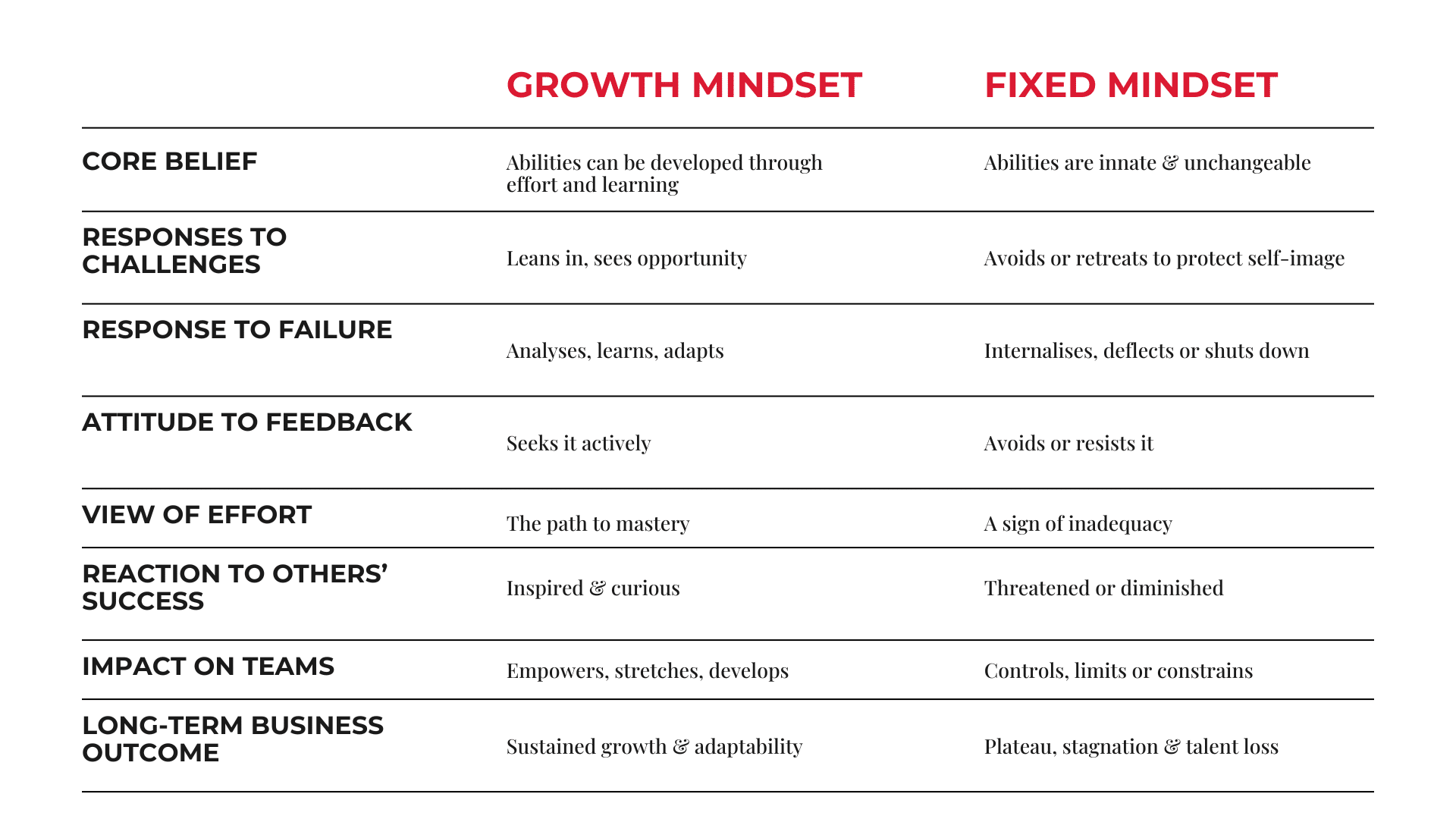
Growth Mindset vs Fixed Mindset: A Quick Comparison
The Bottom Line
The difference between a growth mindset and a fixed mindset is not a personality quirk. It's a fundamental orientation that shapes how you lead, how you grow, and ultimately, how far your business can go.
If you've built something significant, you already have more capability than you give yourself credit for. The question isn't whether you're talented or intelligent or driven; you've already proven that. The question is whether you're willing to keep evolving. To be uncomfortable. To not have all the answers and to lead anyway.
That's what a growth mindset looks like in practice. Not confidence without doubt. Not optimism without realism. But a deep, operational belief that you and your business are capable of more than what exists today.
The leaders who build extraordinary businesses are not the ones who arrive fully formed. They're the ones who never stop forming.
Caroline Kennedy is a former 9-figure CEO turned executive coach and business coach, working with founders and CEOs who are ready to level up and move forward. If you're ready to challenge the thinking that's keeping your business where it is, get in touch.